Category: Browsers & Privacy Tools

Learn how to use Tor, VPNs, and secure operating systems to stay anonymous.

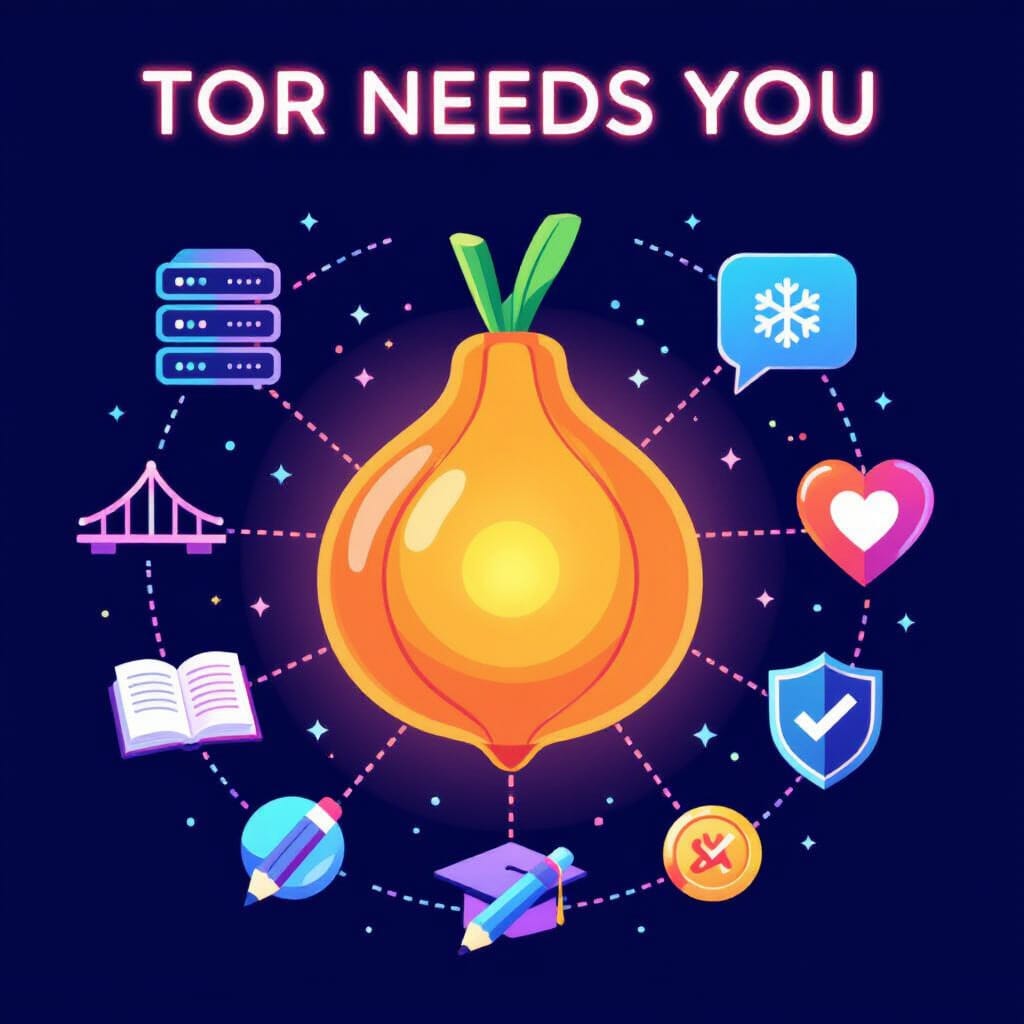
  • Tor Needs You: 10 Easy Ways to Help

    Tor Needs You: 10 Easy Ways to Help

    By [crypto]
    Real Deep web Contributor

    Tor is not a “product” you download and forget. It’s a global public work—kept alive by an unlikely mix of engineers, translators, system administrators, teachers, modest donors, and a handful of institutions that decided privacy was worth funding. If you’ve used Tor to read when others couldn’t, to publish when others were silenced, or simply to go about a lawful life without being watched, the next question is inevitable: How do I give back?

    What follows is a practical map of ways anyone can help.


    Fund what you use

    The uncomfortable truth: privacy costs money. Security audits, patches, directory authorities, usability studies, and fair salaries aren’t paid with enthusiasm but with sustained donations. For most individuals, the most effective gift is modest and monthly—it gives predictability. If your employer offers matching, trigger it; if your foundation funds digital rights, commit multi-year grants. Technical independence relies on financial independence.

    In 5 minutes: become a monthly donor.
    In 1 hour: check if your employer matches; if you lead a team, organize an internal drive.
    Concrete outcome: more engineering time, less time chasing budget.


    Run infrastructure: from “like” to relay

    Tor’s heart is its relays (routing nodes) and bridges (stealth entry points where Tor is blocked). Running one is not heroic; it’s a public service with clear requirements. Diversity matters—more autonomous systems, countries, providers; less monoculture. If your legal context and network allow it, host a middle relay; if you live under censorship, consider a bridge (or run Snowflake in your browser to donate bandwidth in short bursts).

    In 15 minutes: enable Snowflake and share it with your circle.
    Over a weekend: deploy a relay with basic monitoring and a sane abuse policy.
    Caution: read your ISP/datacenter terms and power costs; publish an abuse contact; don’t promise what you can’t sustain.


    Translate where censorship speaks other languages

    Tor lives or dies by linguistic capillarity. Docs, the browser UI, anti-block guides, and teaching materials need translations and reviews that sound native. If you’re bilingual, you can make access comprehensible to those who need it most.

    With 1 hour a week: review new strings, unify glossaries, fix false friends.
    Impact: users who don’t read English stop relying on intermediaries to use Tor safely.


    Teach without myths: literacy and first-line support

    Tor drags legends—“everyone can see you use it,” “it’s illegal,” “it’s only for X”—that scare people off. Be the antidote: short workshops, micro-videos, talks at universities, libraries, newsrooms, or just first-contact support for colleagues. Be clear about limits and strengths; insist on good habits (no extensions, no window resizing, verify downloads); and explain threat models.

    In 30 minutes: give an internal talk: “10 common mistakes and how to avoid them.”
    In an afternoon: host a hands-on session—install, verify signature, practice safe browsing.


    File bugs that help, not complaints that vanish

    All software has flaws. Healthy projects are distinguished by the quality of bug reports: reproducible steps, OS, version, logs, screenshots, and whether it happens on default settings. If you can submit patches (Rust/Go/Python/JS; Firefox ESR under the hood), even better. Useful criticism arrives with data; everything else is noise.

    Effective-report checklist:

    • Does it occur on a clean Tor Browser, no add-ons?
    • Can you describe “step by step” until it breaks?
    • Did you attach logs and the exact version?
    • Did you check for duplicates?

    Improve usability (yes, privacy is also design)

    Security fails on friction. Tor’s research shows tiny changes in copy, visual hierarchy, or install flows reduce errors and drop-offs. If you do UX research, write microcopy, design onboarding, or test accessibility, your skills are gold: the next improvement may be a clearer sentence or a better-placed button.

    Concrete offer: run a remote study with five new users in your language; deliver actionable findings.


    Measure censorship where it hides

    Censorship is easier to challenge when it’s measured. Contribute network tests (checking access to domains and services) to spot Tor blocks, poisoned DNS, and SNI filtering. If you can test across multiple ISPs or regions, your data is doubly valuable. Technical transparency becomes public pressure.


    Advocate: bring the debate to parliaments and courts

    Tor exists partly because legal frameworks still protect encryption and security research. If you work in policy, tech law, or journalism, help counter narratives that equate privacy with impunity. Testify at hearings, write op-eds, explain why backdoors weaken everyone, and document cases where Tor preserved lives, sources, or evidence.


    Host mirrors and “rainy-day” materials

    Where selective blocking is common, having mirrors of docs, signed PDF guides, lists of verifiable fingerprints, and alternative channels (mailing lists, RSS) can make the difference during a blackout week. Resilience isn’t a slogan; it’s a contingency kit.


    Build community—and tend it

    Long-lived projects don’t just write code; they cultivate norms. Welcome newcomers, thank contributors, review pull requests respectfully, moderate without humiliating, and remember that many participants are at risk. The culture you model today becomes tomorrow’s magnet—or repellent—for volunteers.


    If you only have…

    • 5 minutes: start a monthly donation; enable Snowflake.
    • 1 hour: verify your Tor Browser signatures, update, share a short guide.
    • A weekend: stand up a documented relay/bridge; host an “install & learn” session for your group.
    • A month: organize a matched-giving drive, or coordinate a usability study in your language.

    A note of realism (and safety)

    Before hosting infrastructure, read your legal framework and provider policies. If your personal risk is high, prioritize education, translation, and donations. Not everyone must run the same marathon. Tor’s strength is its ecosystem: many small, steady contributions—less glamour than discipline.


    Final Thoughts

    It’s tempting to romanticize Tor as a cryptographic cathedral built by geniuses. The reality is more ordinary—and more hopeful: a commons, assembled from monthly pledges, weekend relays, fourth-pass edits to a manual, and servers nobody applauds but everybody needs. Helping the Tor Project isn’t grand theater; it’s a subscription, a well-tended relay, a clearer paragraph. In short, it’s sustaining public infrastructure for a private right: to read, speak, and live without being watched.

  • They Can’t Find You If You Don’t Exist: Mastering OPSEC

    They Can’t Find You If You Don’t Exist: Mastering OPSEC

    By [crypto]

    Real Deep web Contributor

    In a hyper-connected world where nearly every click, search, and interaction is recorded, the idea of vanishing from the digital realm may seem like a fantasy. But for a growing subculture of internet users, this aspiration is a way of life. Known as OPSEC—short for Operational Security—this movement borrows tactics from military intelligence and cybersecurity professionals to teach individuals how to live without leaving a trace. Whether motivated by privacy concerns, fear of surveillance, or a desire for anonymity, those who practice OPSEC are mastering the art of digital disappearance.

    In an age dominated by data harvesting, facial recognition, and algorithmic tracking, the OPSEC lifestyle has gone from fringe curiosity to urgent relevance.

    The Origins and Philosophy of OPSEC

    Originally a term coined by the U.S. military during the Vietnam War, OPSEC refers to a process of protecting sensitive information from adversaries. In civilian life, it has evolved into a framework used by journalists, whistleblowers, political dissidents, and privacy advocates to shield personal data and limit exposure to surveillance.

    At its core, OPSEC isn’t just a set of tools—it’s a mindset. Practitioners adopt a defensive posture toward technology, constantly evaluating their digital habits, identifying vulnerabilities, and minimizing risk. While some aim to achieve total anonymity, others simply want to regain control over their digital footprint in a world increasingly hostile to privacy.

    Why People Are Going Dark

    From governments and corporations to hackers and data brokers, nearly every corner of the internet is designed to extract value from our online behavior. Common motivations for adopting OPSEC include:

    • Mass Surveillance: Revelations by Edward Snowden in 2013 exposed the scale of state-sponsored surveillance by the NSA and other intelligence agencies.
    • Data Breaches: High-profile breaches at Equifax, Facebook, and others have left billions of personal records exposed.
    • Cancel Culture and Doxxing: Activists, whistleblowers, and controversial public figures often seek OPSEC measures to avoid harassment, threats, or professional consequences.
    • Cybercrime: Ransomware attacks and identity theft have made digital security a practical necessity.

    For these individuals, privacy is not a preference—it’s a form of protection.


    The OPSEC Guide: How to Leave Zero Digital Footprint

    While achieving total anonymity is extremely difficult, it’s possible to dramatically reduce your digital footprint by following a layered OPSEC strategy. Here is a comprehensive guide to the tools, principles, and practices used by those who aim to disappear online.

    Erase Your Existing Digital Footprint

    • Delete Social Media Accounts: Start with Facebook, Instagram, Twitter, TikTok, LinkedIn, and Reddit. Use services like JustDelete.me to find account deletion links.
    • Remove Yourself from Data Brokers: Sites like Spokeo, Whitepages, and BeenVerified collect and sell your data. Use opt-out forms to request removal.
    • Delete Search Engine Histories: Clear history and request data deletion from Google, Bing, and other engines. Use Google’s My Activity for account-level deletions.
    • Scrub Old Content: Contact webmasters to delete old blog posts, comments, or forum entries tied to your name or email.

    Replace Identity with Aliases (Pseudonymity)

    • Use a consistent alias for all future online activity.
    • Create new email accounts using anonymous services like ProtonMail or Tutanota.
    • Never use your real name, birthday, or personal information for account registrations.

    Use Secure Hardware and Operating Systems

    • Use Privacy-Focused Operating Systems: Consider Tails or Qubes OS.
    • Avoid Smartphones: If necessary, use GrapheneOS on a compatible Pixel device.
    • Disable Microphones and Cameras: Use tape or hardware blockers, or purchase laptops with physical kill switches.

    Practice Safe Browsing

    Encrypt Everything

    Mask IP and Location

    • Use a Reliable VPN:
    • Use Tor: Layer VPN + Tor for enhanced anonymity.
    • Avoid Wi-Fi: Use Ethernet or public access points with MAC address spoofing.

    Pay Anonymously

    Compartmentalize Your Digital Life

    • Never reuse usernames or emails across different platforms.
    • Create different “personas” using separate browsers, OS accounts, or virtual machines.

    Physical OPSEC Matters Too

    • Avoid surveillance cameras and RFID-tagged cards.
    • Use Faraday bags to block GPS signals.
    • Pay in cash when possible.

    Build a Threat Model

    Identify your adversaries and assess what they can access. Tailor your strategy accordingly—journalists, for instance, may need different tools than someone escaping online harassment.


    The Culture of OPSEC: More Than Tools, It’s a Way of Thinking

    For practitioners of OPSEC, it’s not just about installing the right browser or deleting an old Facebook post. It’s a philosophy of awareness, grounded in skepticism of systems that commodify identity and behavior. The OPSEC community is diverse: investigative journalists, political activists, whistleblowers, cryptocurrency traders, and ordinary citizens disillusioned by the erosion of privacy.

    Online forums, encrypted group chats, and Dark Web communities are hubs for exchanging new techniques and raising awareness about vulnerabilities. For some, it’s about digital survival; for others, it’s a protest against surveillance capitalism.

    But the lifestyle has trade-offs: isolation, paranoia, and the constant need to stay updated as technologies evolve. “Being off-grid means giving up convenience,” says one anonymous privacy advocate, “but it also means regaining agency.”


    Is True Digital Disappearance Possible?

    In truth, erasing yourself completely from the internet is nearly impossible. Legacy data, third-party leaks, and interconnected networks mean some traces may linger indefinitely. Yet OPSEC is not about perfection—it’s about resilience. It’s about shifting the balance of power back to the individual, reducing your data exposure, and making it exponentially harder for adversaries to track, profile, or exploit you.

    As the digital world grows more invasive, the tools and mindset of OPSEC may soon become essential literacy—not just for hackers and activists, but for anyone who values freedom in the information age.